To participate in Farcaster SocialFi yield farming, link a funded EVM wallet to a client like Warpcast, interact with verified DeFi Frames on the Base L2 network, and route liquidity to decentralized exchanges like Aerodrome. Advanced users automate yields by running Farcaster Hubs and utilizing Neynar API webhooks to trigger smart contracts based on social engagement metrics.
Farcaster has systematically mutated from a decentralized messaging protocol into a high-octane liquidity execution layer on the Base network. By 2026, the boundaries separating social graphs from decentralized finance have entirely dissolved, replacing passive scrolling with active financial strategy. Users are no longer just publishing text; they are executing smart contracts, minting yield-bearing assets, and extracting cross-protocol rewards directly through their Warpcast feeds.
Project Overview & Utility: The Social-to-DeFi Bridge
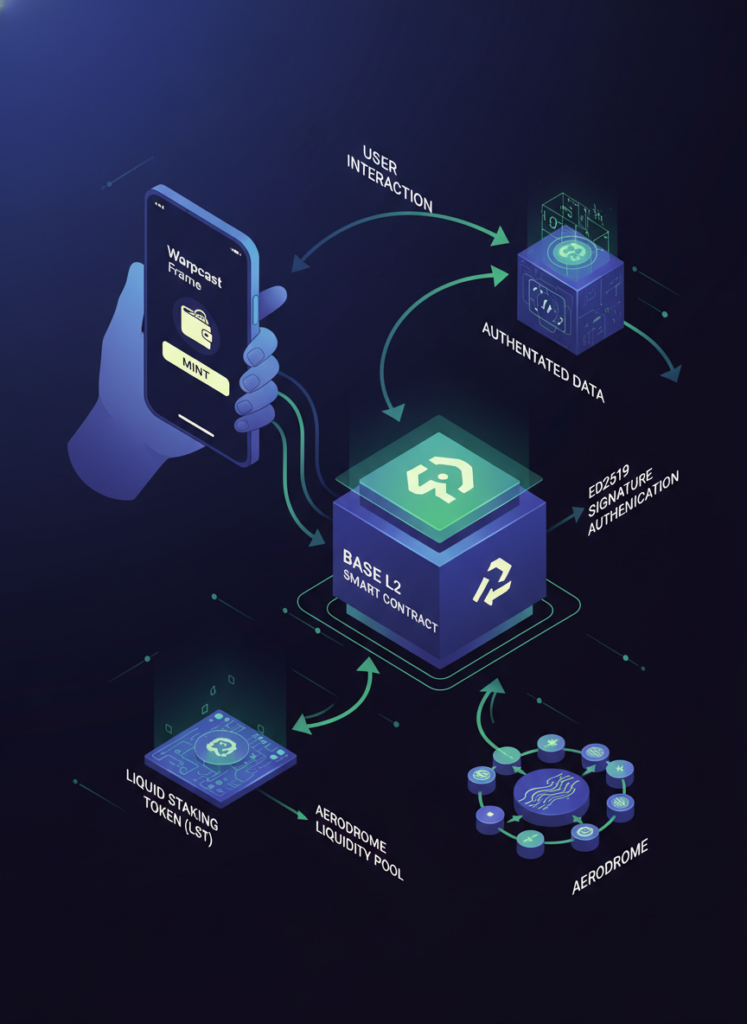
The fundamental innovation driving Farcaster’s financialization is the ‘Frame’ architecture. Frames operate as interactive mini-dApps injected directly into the social feed, powered by OpenGraph tags and authenticated by user wallets via Ed25519 signatures. This infrastructure allows users to approve transactions without leaving their client. Consequently, we are seeing the rapid deployment of Farcaster integrated liquid restaking protocols on Ethereum L2, where users deposit ETH directly through a social post, routing it to EigenLayer or Lido, and receiving liquid staking tokens natively on Base while accruing off-chain social rewards.
Understanding how to participate in Farcaster frame yield farming on Base requires a grasp of the underlying execution environment. You are not manually signing multiple approvals on a standard decentralized exchange interface. Instead, you link an EVM-compatible wallet (typically via Coinbase Wallet or Metamask) to your Farcaster account. When a verified DeFi protocol broadcasts a Frame, your client reads the call data, and with one click, you supply liquidity or execute a swap, benefiting from Base’s sub-cent gas fees.
Deep-Dive Technical Analysis: $DEGEN, $WARPS, and Protocol Economics
The dual-asset model operating within the Farcaster ecosystem creates unique arbitrage and yield generation vectors. While $WARPS function purely as an off-chain accounting metric used to pay for protocol actions (like minting NFTs or launching new channels), $DEGEN is an ERC-20 asset on the Base network that operates with an algorithmic emission schedule tied to user engagement.
To effectively map out yield projections, one must analyze the liquidity pools. Many power users are aggressively yield farming social tokens on Aerodrome via Warpcast. By pairing $DEGEN with WETH on Aerodrome Finance, liquidity providers earn trading fees plus protocol emissions. Crucially, sophisticated actors then embed these liquidity pool interfaces directly into Frames, allowing followers to auto-compound their positions.
| Token / Asset | Classification | Primary Utility | 2026 Yield Strategy |
|---|---|---|---|
| $DEGEN | ERC-20 (Base) | Tipping, Governance, Liquidity | LPing on Aerodrome, automated tipping bots |
| $WARPS | Off-chain ledger | Paying client fees, gifting | Non-yield bearing; used for operational overhead |
| Channel NFTs | ERC-721 (Base) | Access control, status | Renting channel access, gating premium Frames |
Identifying the best farcaster channels for earning degen tips 2026 requires monitoring decentralized analytics. Channels like /degen, /base, and /farcon maintain algorithmic allowances that distribute tokens based on engagement metrics weighted by the initiator’s social rank.
How to automate $DEGEN tipping with Farcaster AI agents?
Manual engagement does not scale for serious yield farmers. The technical pivot involves building or deploying automated socialfi yield strategies using neynar API infrastructure. Developers utilize Neynar’s webhooks to monitor specific Farcaster network events—such as a user casting a specific hashtag or hitting a predefined like threshold.
Once the webhook triggers, an AI agent (often hosted on secure enclaves) parses the text to determine intent and executes a smart contract call on Base to tip $DEGEN automatically. To set this up:
- Provision a developer account on Neynar and generate API keys.
- Configure a webhook targeting the
cast.createdevent within specific channels. - Write a localized Node.js script using the
viemlibrary to sign EVM transactions based on the webhook payload. - Deploy the script to a cloud function, maintaining a hot wallet funded with a strict $DEGEN allowance for security.
What is the current storage fee for Farcaster Hubs on the Base L2?
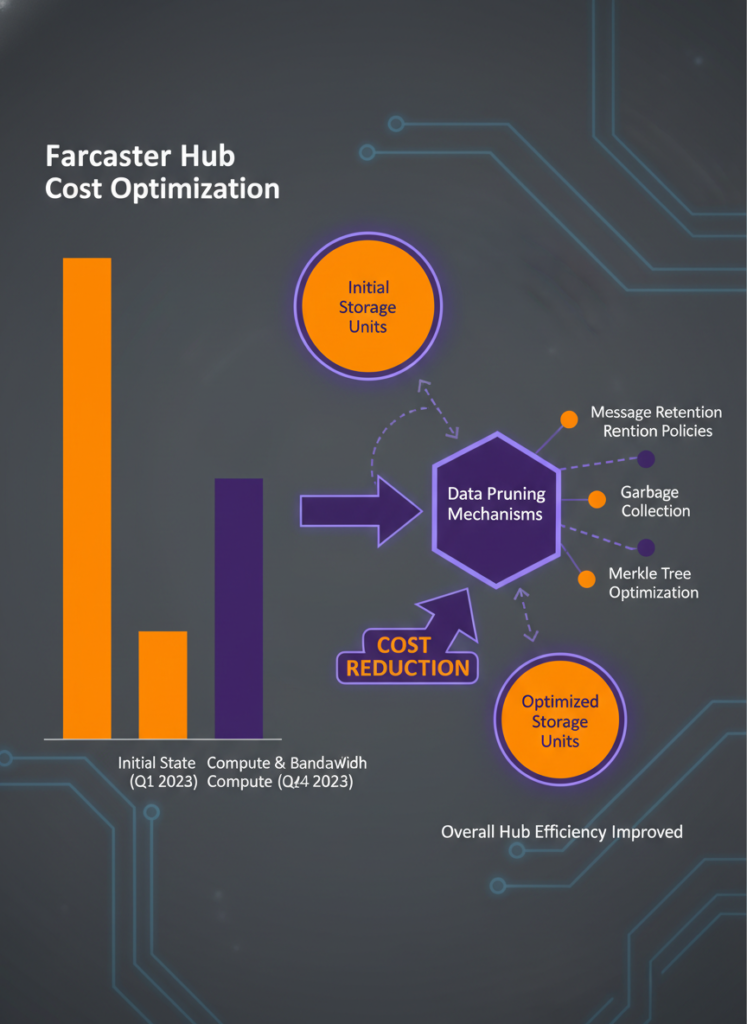
Unlike traditional blockchains where state is kept forever, Farcaster requires users to pay rent for delta-graph storage via Hubs. The network charges an annual fee per storage unit (which holds roughly 5,000 casts, 2,500 reactions, and 2,500 links). In mid-2026, network consensus prices a single storage unit at approximately $5.00 USD (roughly £3.80 GBP or $6.80 CAD), payable in cryptocurrency.
For enterprise users and automated tip bots, Farcaster hub storage optimization for low-cost social mining is critical. Node operators aggressively prune stale cryptographic signatures and offload legacy message data to decentralized cold storage (like Arweave) to prevent paying excess rent, keeping operating margins thin and yield retention high.
How do I link a Zora NFT mint to a Farcaster Frame for yield?
Zora’s protocol-level fee structure offers another lucrative revenue stream. Whenever a user mints a Zora-deployed NFT, a 0.000111 ETH fee is collected. If that mint is executed through a Farcaster Frame, the Frame creator receives a percentage of that fee as an affiliate reward.
- Deploy an ERC-1155 contract using Zora’s native creator tools on Base.
- Utilize a Frame-builder framework (like Frog or OnchainKit) to generate the OpenGraph metadata for your NFT.
- Embed your Ethereum address in the
minttransaction call data as the referrer. - Broadcast the Frame link on Warpcast.
This method essentially creates a micro-economy. Astute operators also investigate how to earn passive income from farcaster channel ownership by pinning these high-conversion Zora mint Frames to the top of highly trafficked, niche community channels they administer.
Reputation & Undercollateralized Lending
The most aggressive frontier is bridging social reputation to defi credit scores on farcaster. Because Farcaster IDs (FIDs) are tied to verifiable on-chain history and require paid storage, they inherently carry a high cost of forgery (Sybil resistance). DeFi protocols are currently experimenting with reading Farcaster user graphs to issue undercollateralized loans. If a user holds an FID below 10,000 (indicating early adoption) with significant $DEGEN transaction history, smart contracts can grant them preferential borrowing rates on Base native lending markets.
Is yield farming on SocialFi protocols safer than traditional DeFi in 2026?
SocialFi introduces distinct attack vectors absent in pure DeFi environments. While the underlying Base L2 settlement layer remains highly secure, the application layer—specifically Frames—presents novel vulnerabilities. Users must be hyper-aware of the security risks of third-party farcaster frames for yield. Malicious actors frequently deploy visually identical Frames containing spoofed contract call data designed to drain wallet approvals rather than supply liquidity.
Pros and Cons of Farcaster Yield Farming:
- Pro: Zero-friction onboarding; execute complex LP positions natively within a social feed.
- Pro: Dual-yield opportunities combining traditional DEX fees with social token emissions.
- Pro: Strong Sybil resistance ensures genuine human interaction drives token distribution.
- Con: High risk of signature phishing through unverified or spoofed Frames.
- Con: Extreme volatility of social tokens like $DEGEN compared to blue-chip DeFi assets.
- Con: Constant UI/UX changes as client applications (like Warpcast) update their API specifications.
Competitor Comparison: Farcaster vs. Lens Protocol
When comparing Farcaster and Lens protocol yield opportunities 2026, the architectural differences dictate the financial outcomes.
Lens Protocol, operating primarily on the Polygon ecosystem via Momoka for data availability, enforces monetization at the protocol level (e.g., pay-to-collect modules). This creates a predictable but rigid creator economy. Farcaster, conversely, embraces permissionless off-chain architecture combined with Base L2 execution. Farcaster does not dictate how users monetize; it merely provides the canvas (Frames) and the settlement speed. Consequently, Farcaster has attracted a much deeper pool of traditional DeFi liquidity, making its yield farming ceilings significantly higher, albeit more complex to navigate than Lens’s plug-and-play modules.
Is the Farcaster native protocol token airdrop still planned for late 2026?
The speculation surrounding a native Farcaster protocol token has driven massive farming behavior, though core developers maintain that $WARPS and ETH suffice for network operations. As of late 2026, there is no verified smart contract or public GitHub repository confirming an imminent core protocol airdrop. The prevailing market consensus suggests that the ecosystem will continue utilizing $DEGEN as the de facto decentralized index of the network’s health, rather than introducing an administrative governance token that could attract regulatory scrutiny.
Final Verdict & Market Outlook
Farcaster-integrated SocialFi yield farming is not for the passive retail investor. It requires a robust understanding of EVM mechanics, API management, and the risk profiles of algorithmic social tokens. However, for the technically adept operator capable of deploying automated Neynar-backed strategies and evaluating smart contract data within Frames, it represents the most capital-efficient intersection of attention economics and decentralized finance available on the Base L2.
About the Author: Ehsaan is a Senior Product Reviewer and DeFi systems architect with over nine years of experience analyzing Ethereum layer-2 scaling solutions and smart contract mechanics. Having previously engineered automated liquidity provisioning systems for institutional funds, Elias now focuses on the intersection of social graphing and decentralized finance, providing rigorous, data-driven analysis of emerging protocol economies.