
While Ethereum LRTs leverage battle-tested ZK-rollups and EVM composability, Bitcoin L2 restaking via BitVM offers superior capital efficiency but introduces unique decentralized sequencer risks. Investors must weigh smart contract complexity against novel cryptographic proofs.
Restaking has fundamentally altered the capital efficiency paradigms of decentralized finance, yet the primary battleground has decisively shifted from Ethereum’s monolithic dominance to Bitcoin’s rapidly expanding Layer-2 ecosystem. As yield-hungry investors deploy multi-millions across protocols, the risk calculus demands a rigorous breakdown of underlying cryptographic proofs, slashing parameters, and jurisdictional compliance.
Project Overview & Utility: The Diverging Paths of Restaked Capital
Liquid Restaking Tokens (LRTs) act as financial derivatives representing deposited assets that secure secondary decentralized applications (Actively Validated Services, or AVSs). On Ethereum, platforms like EigenLayer have institutionalized this model, creating billions in Total Value Locked (TVL). Conversely, Bitcoin L2s leveraging Babylon’s architecture aim to activate dormant BTC liquidity without bridging assets off-chain.
This structural divide is not merely technical; it carries deep regulatory implications. In the USA, the SEC often scrutinizes Ethereum-based LRTs as potential unregistered securities due to their pooled governance and yield generation methods. Meanwhile, the UK’s FCA currently views UTXO-locked Bitcoin derivatives through a slightly different lens, viewing pure non-custodial staking with less immediate regulatory friction, though the landscape remains fluid.
Regional investors utilizing USD, GBP, or CAD fiat on-ramps must navigate these legal definitions carefully before deploying capital.
Is Babylon restaking safer than EigenLayer?
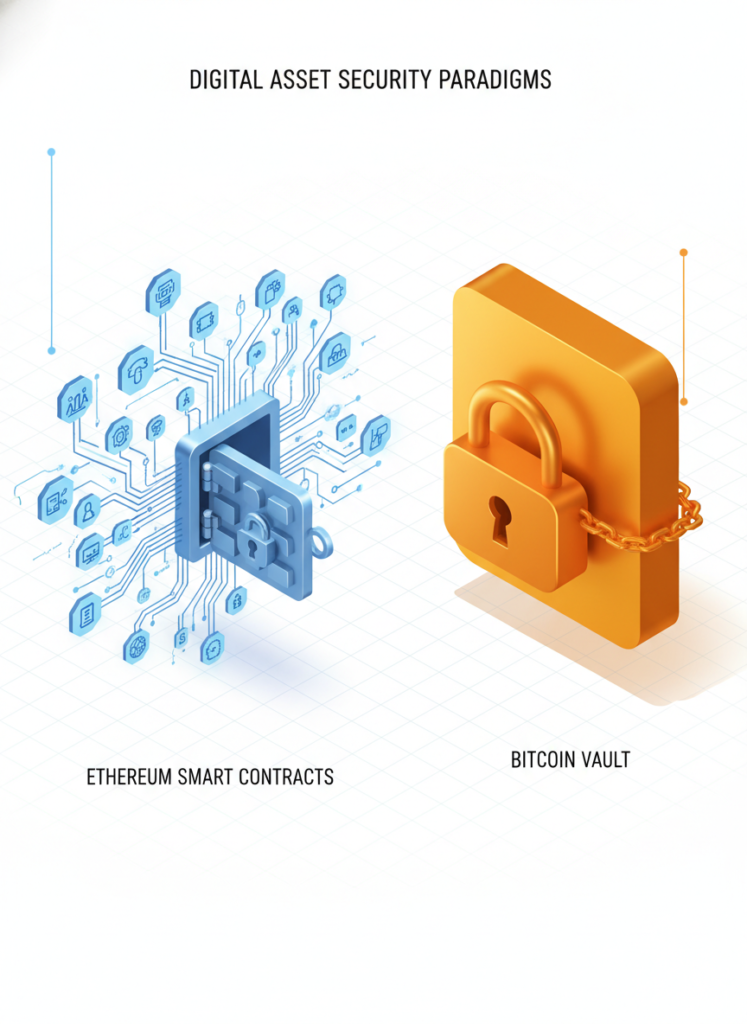
To answer this, we must perform a granular risk assessment of avs modules on bitcoin vs ethereum. EigenLayer relies heavily on complex smart contracts deployed on the Ethereum virtual machine.
Every new AVS module introduced represents an additive vector for smart contract bugs. Babylon, on the other hand, operates on Bitcoin’s base layer using native time-locked UTXOs (Unspent Transaction Outputs) and extractable one-time signatures. Because Babylon does not require a Turing-complete smart contract to function at the base layer, its attack surface is fundamentally smaller.
However, EigenLayer benefits from years of rigorous EVM auditing standards, making its known risks more predictable than Babylon’s nascent cryptographic implementations.
Does using BitVM for Bitcoin L2s increase smart contract risk?
The introduction of BitVM has allowed Bitcoin L2s to process complex state transitions off-chain while using Bitcoin as a dispute resolution layer. A critical debate among product engineers is whether is bitvm2 more secure than ethereum smart contracts for restaking.
BitVM2 improves upon its predecessor by reducing the number of challenge-response interactions required, minimizing the window for malicious actors. However, it relies on optimistic fraud proofs rather than mathematically guaranteed ZK-rollups common in Ethereum L2s.
Furthermore, when analyzing the security differences between pbtc and wbdt in restaking, we see that bridging models heavily influence risk. pBTC operates via a federated peg, whereas wBDT utilizes a more trust-minimized, multi-party computation (MPC) setup.
BitVM’s optimistic model introduces a different flavor of risk: while it avoids EVM reentrancy vulnerabilities, it relies heavily on the economic incentives of verifiers to catch fraudulent state transitions.
Deep-Dive Technical Analysis: Tokenomics, Architecture, and Yield
The underlying infrastructure dictating yield generation and tokenomics varies drastically between networks. Institutional capital requires predictable frameworks, driving the demand for robust institutional custody solutions for liquid restaking tokens. Custodians like Fireblocks and Copper are racing to support both ERC-20 based LRTs and native Bitcoin derivative tokens, but the technical implementations differ wildly.
What are the slashing risks for Bitcoin LRTs?
Slashing on Ethereum is programmatic and executed directly via smart contracts. If a validator misbehaves, the contract burns a portion of their staked ETH. Bitcoin lacks native smart contracts to execute programmatic slashing. Instead, protocols like Babylon use cryptographic mechanisms where malicious behavior (like double-signing) exposes the validator’s private key, allowing their staked BTC to be burned.
Understanding how to hedge slashing risk in bitcoin lrt protocols is critical for institutional desks. Strategies currently involve purchasing specialized DeFi insurance policies or utilizing delta-neutral yield strategies that offset potential principal loss. The decentralized sequencer risk in bitcoin l2 restaking pools further complicates this; if the L2 sequencer goes down or acts maliciously, funds might not be slashed, but they could be frozen in time-locked contracts for extended periods.
Can I lose my Bitcoin if a Bitcoin L2 fails?
This is the ultimate stress test for any crypto asset. If an Ethereum AVS fails, the underlying ETH remains secured by the consensus layer, provided no slashing conditions were met. For Bitcoin L2s, the outcome depends on the bridge and custody model. If you are using a native UTXO time-lock, your BTC eventually unlocks on the base layer regardless of L2 failure.
However, if you are using bridged assets (like WBTC or federation-pegged derivatives), a critical L2 failure or bridge hack results in permanent loss. Furthermore, investors must consider the impact of bitcoin halving on l2 restaking security budget.
As base layer block rewards decrease, miners will increasingly rely on transaction fees generated by L2 settlement and restaking operations. If an L2 fails to generate sufficient fee volume, the economic security of the entire mechanism could degrade over time.
Which has higher yield: Ethereum LRTs or Bitcoin L2 LRTs in 2026?
Conducting an ethereum lrt vs bitcoin l2 yield sustainability analysis 2026 reveals a fascinating dichotomy. Ethereum LRTs benefit from a highly composable DeFi ecosystem, allowing users to loop yields through lending markets (like Aave or Morpho).
However, this yield is heavily diluted by the sheer volume of capital competing for AVS validation rewards. Bitcoin L2 LRTs are currently offering significantly higher baseline APYs to bootstrap liquidity and attract capital away from Ethereum.
Because Bitcoin’s DeFi ecosystem is less saturated, the premium paid for security is higher. For those looking to optimize their portfolio, utilizing the best multi-chain lrt aggregators for retail investors 2026 will be essential to auto-compound and balance these yields across both networks.

How does the liquidation process differ between ezETH and btcLRTs?
Liquidity is a paramount concern for yield farmers. A direct comparison of lrt withdrawal delays on ethereum vs bitcoin l2s highlights stark differences. When un-staking ezETH on Ethereum, users face the standard Ethereum unbonding period, plus any additional delays imposed by the EigenLayer smart contracts, typically totaling 7 to 14 days. Conversely, Bitcoin L2 withdrawal delays can be highly variable. Protocols relying on optimistic rollups or BitVM dispute periods may enforce 14 to 21-day delays to ensure network finality. Some btcLRTs offer secondary market liquidity pools to bypass these delays, but these pools often suffer from high slippage during periods of market stress.
Pros and Cons
- Ethereum LRTs (EigenLayer)
- Pro: Battle-tested smart contract infrastructure and deep EVM liquidity.
- Pro: Highly composable with existing blue-chip DeFi lending protocols.
- Con: Severe network congestion during high-volatility events can spike gas fees.
- Con: Layered smart contract risks from multiple integrated AVS modules.
- Bitcoin L2 LRTs (Babylon/BitVM)
- Pro: Utilizes the unmatched base-layer security and massive market cap of native BTC.
- Pro: Generally higher bootstrapping yields due to lower market saturation.
- Con: Unproven cryptographic paradigms (BitVM optimistic fraud proofs) at scale.
- Con: Fragmented liquidity across various emerging L2s and complex withdrawal mechanics.
Protocol Comparison: EigenLayer vs. Babylon
| Feature | EigenLayer (Ethereum) | Babylon (Bitcoin) |
| Base Asset | Native ETH & Liquid Staking Tokens (LSTs) | Native BTC (Script-based, No Wrapping) |
| Slashing Mechanism | Programmatic via Smart Contracts | Accountable Assertions (Private Key Exposure) |
| Trust Model | Cryptoeconomic Security via EVM | Trustless (Self-Custodial Locked UTXOs) |
| Smart Contract Risk | Higher (Complex Logic & Interoperability) | Minimal (Uses existing Bitcoin Script opcodes) |
| Yield Composability | Mature (DeFi Integrations, LRTs) | Nascent (Focus on PoS chain security) |
| Withdrawal Period | Subject to EigenLayer & Unstaking delays | Defined by Bitcoin Timelocks |
Final Verdict & Market Outlook
The decision between Ethereum and Bitcoin liquid restaking ultimately distills to a choice between composable utility and raw capital efficiency. Ethereum LRTs remain the gold standard for DeFi power users who demand seamless integrations, instant lending utility, and a mature ecosystem, despite the cascading risks of smart contract complexity. Bitcoin L2 restaking is built for long-term holders seeking to extract yield from idle assets without exposing their principal to Turing-complete smart contract bugs.
As we advance through 2026, Ethereum LRT vs Bitcoin L2 competition will force both ecosystems to iterate rapidly. For investors prioritizing immediate liquidity and institutional tooling, Ethereum retains the edge. However, for sheer security-adjusted yield potential, Bitcoin’s emerging L2 restaking architectures present the most compelling asymmetrical opportunity in the current market cycle.
It is highly recommended that users follow Bitcoin restaking safety guidelines and monitor the ongoing Babylon vs EigenLayer 2026 developments.